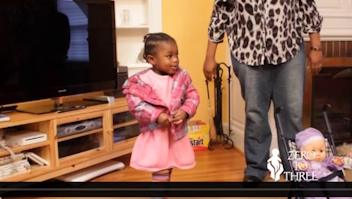
This humorous video shows a father having fun playing with his young daughter. But the fathers’ mother thinks he has gone crazy. Slowly the villagers convince the grandmother that playing with the children is beneficial for the fathers and the children. The fathers feel closer to their children and it helps the children become more intelligent.Read More →

This video was created by Moana Research in New Zealand and adapted with permission by the Center on the Developing Child at Harvard University and in collaboration with Brainwave Trust Aotearoa. It explains and illustrates five steps of “serve and return” interactions that are core to responsive caregiving and brain building. Read More →

Este vídeo explica e ilustra los cinco pasos de las interacciones de «servir y volver» que son fundamentales para el atención receptiva y necesarias para la construcción del cerebro. Los cinco pasos son: 1) comparte su interés; 2) apoya y anima; 3) nómbralo; 4) tomen turnos; y 5) practiquen los finales y los incios.Read More →

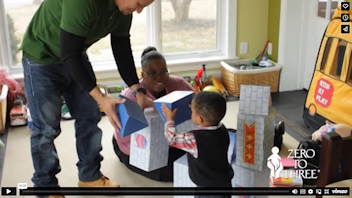
The father and his 2.5-3 year old son are looking through the picture book together. Notice what the child does and what the father does in response.Read More →

The Beginning of Life (O Começo da Vida) emotionally brings to life the science behind the importance of loving relationships in a child’s early years. Interviews with experts are interspersed with footage of parents and children from nine countries across four continents. Read More →

This video illustrates how the connections between the neurons in our brain are formed in early childhood, how genes and experiences shape these connections, and how these connections then create the foundation for all future learning and development.Read More →

Part of UNICEF Mini parenting Master class series, Prof. Jack Shonkoff explains the importance of play for brain development. He explains why and how to practice “serve and return” interactions and the value of games such as peek-a-boo for children’s mastery of new skills. Read More →

This funny video uses an example of freshly caught vs. dried fish to illustrate the plasticity of a child’s brain.Read More →

This video from the Van Leer Foundation makes the case that we need an all-of-society and all-of-government approach to better support parents. The video accompanies Early Childhood Matters 2025: The well-being Issue Part II.Read More →

This knowledge hub compiles national documents, assessments, job aids, training materials, and quality improvement tools, developed by PATH in collaboration with government and partners across Eastern and Southern Africa, to support the promotion of nurturing care for early childhood development through existing health and nutrition services.Read More →

Through tender portrayals of heartfelt moments, challenges, fears, and the sheer joy of fatherhood, this endearing short film highlights that men are often hard on themselves with respect to their role as father. Yet it is not perfection that young children value but closeness, meaningful relationships, and cherished time together.Read More →

Sheila Manji, Spécialiste du développement de la petite enfance, Le Partenariat pour la santé de la mère, du nouveau-né et de l’enfant, présent des ressources disponibles en français, afin de faciliter le plaidoyer et la mise en œuvre du cadre des soins attentifs. Par exemples, les définitions des composantes des soins attentifs, les messages clés et les profils des pays. Read More →

Laura Rawlings, Économiste principal, Project du Capital Humain, Banque mondiale, explique le lien entre le développement de la petite enfance et le capital humain. Description de l’indice du capital humain crée par la Banque mondiale.Read More →

Maniza Ntekim, Conseillère Régionale, Développement de la petite enfance, UNICEF, initroduit la présentation conjointe de la Banque mondiale et de l’Organisation mondiale de la Santé avec une explication du développement de la petite enfance.Read More →

These ten instructional videos, available in English, Arabic, French, Kyrgyz, Portuguese, Russian, and Spanish, are for health workers and other early childhood service providers who work with mothers, fathers, and other caregivers of young children. The goal of the videos is to improve the quality of counseling and other services that promote responsive care.Read More →

Développement de la petite enfance (UNICEF); Pourquoi est-il important d’investir tôt? (Banque Mondiale); Le cadre des soins attentifs pour le développement de la petite enfance (OMS); Les composantes « opportunités pour l’apprentissage précoce » et « les soins répondant aux besoins » (Le Partenariat pour la santé de la mère, du nouveau-né et de l’enfant); Renforcer les services existants : exemples venant d’Afrique (UNICEF); Ressources pour soutenir le plaidoyer et la mise en œuvre du cadre des soins attentifs (Le Partenariat pour la santé de la mère, du nouveau-né et de l’enfant).Read More →