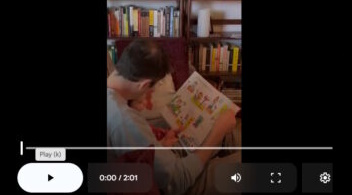
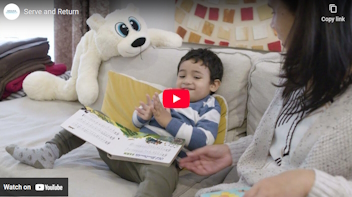
This video was created by Moana Research in New Zealand and adapted with permission by the Center on the Developing Child at Harvard University and in collaboration with Brainwave Trust Aotearoa. It explains and illustrates five steps of “serve and return” interactions that are core to responsive caregiving and brain building. Read More →
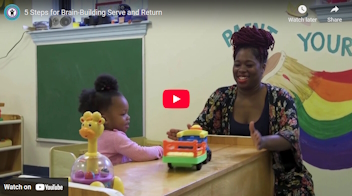
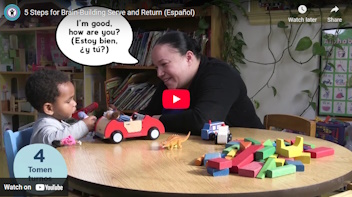
Este vídeo explica e ilustra los cinco pasos de las interacciones de «servir y volver» que son fundamentales para el atención receptiva y necesarias para la construcción del cerebro. Los cinco pasos son: 1) comparte su interés; 2) apoya y anima; 3) nómbralo; 4) tomen turnos; y 5) practiquen los finales y los incios.Read More →

The father and his 2.5-3 year old son are looking through the picture book together. Notice what the child does and what the father does in response.Read More →

The Beginning of Life (O Começo da Vida) emotionally brings to life the science behind the importance of loving relationships in a child’s early years. Interviews with experts are interspersed with footage of parents and children from nine countries across four continents. Read More →

This video illustrates how the connections between the neurons in our brain are formed in early childhood, how genes and experiences shape these connections, and how these connections then create the foundation for all future learning and development.Read More →

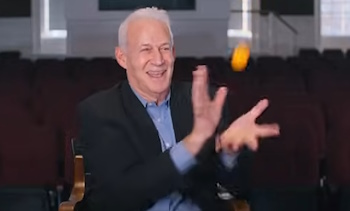
Part of UNICEF Mini parenting Master class series, Prof. Jack Shonkoff explains the importance of play for brain development. He explains why and how to practice “serve and return” interactions and the value of games such as peek-a-boo for children’s mastery of new skills. Read More →

This funny video uses an example of freshly caught vs. dried fish to illustrate the plasticity of a child’s brain.Read More →

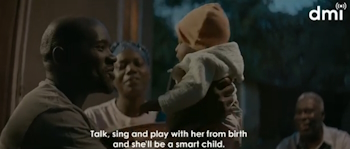
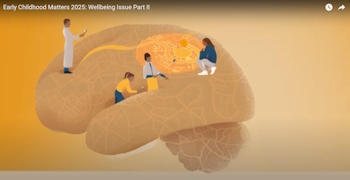
This video from the Van Leer Foundation makes the case that we need an all-of-society and all-of-government approach to better support parents. The video accompanies Early Childhood Matters 2025: The well-being Issue Part II.Read More →

UNICEF, in collaboration with the University of the Witwatersrand and WHO, have created the Caring for the Caregiver package to increase frontline workers’ capacity to provide counselling and parenting support services. Using a family centered approach, the CFC improves caregivers’ emotional well-being and their social support to enable nurturing care for improved child development outcomes.Read More →

UNICEF, in collaboration with the University of the Witwatersrand and WHO, have created the Caring for the Caregiver package to increase frontline workers’ capacity to provide counselling and parenting support services. Using a family centered approach, the CFC improves caregivers’ emotional well-being and their social support to enable nurturing care for improved child development outcomes.Read More →

Videos are a powerful learning tool. They bring concepts to life, demonstrate how to do something, and prompt new ideas and ways of thinking. Videos can also help make trainings more dynamic and explain or reinforce concepts that would otherwise take significant time to explain again and again. Use theseRead More →

This report provides state-of-the-art evidence paving the way for informed decision-making and targeted nutrition and child development interventions, fostering a healthier future for Lebanon’s most vulnerable populations. It underscores the urgent need for multi-sectoral collaboration and the prioritisation of national nutrition and child development strategies to address the child growth and development crisis.Read More →

This knowledge hub compiles national documents, assessments, job aids, training materials, and quality improvement tools, developed by PATH in collaboration with government and partners across Eastern and Southern Africa, to support the promotion of nurturing care for early childhood development through existing health and nutrition services.Read More →

This collaborative venture is a multi-stakeholder initiative that provides a shared vision, identity and platform to amplify the work of its partners to protect children’s environmental health. Partners are united around a common vision – that all children deserve to grow up in a clean, healthy and sustainable environment. Read More →