Early childhood development in emergencies
This 15-minute pre-recorded presentation was prepared by the World Health Organization for the International Conference on Early Childhood Development in Islamabad, Pakistan (February 2023).Read More →


Forty-two randomised controlled trials with 15,557 infants were included in the narrative synthesis to determine the effect of early childhood development interventions delivered by healthcare providers (HCP-ECD) on child cognition and maternal mental health.Read More →
This open-access package is designed to provide a standardized method for measuring development of children birth to 36 months of age at population and programmatic levels globally. The GSED measures capture child development holistically through a common unit, the Developmental score (D-score). The package includes the Short and Long Forms, scoring guide, adaptation and translation guide and a technical report that summarizes the creation process of the GSED, the validation methodology and psychometric properties.Read More →
These guidelines provide evidence-based recommendations on parenting interventions for parents and caregivers of children aged 0-17 years that are designed to reduce child maltreatment and harsh parenting, enhance the parent-child relationship, and prevent poor parent mental health and child emotional and behavioural problems.Read More →
This report summarizes the findings of a multicountry study examining the impact of formula milk marketing on infant feeding decisions and practices, which was commissioned by WHO and UNICEF. The research study – the largest of its kind to date – draws on the experiences of over 8500 women and more than 300 health professionals across eight countries (Bangladesh, China, Mexico, Morocco, Nigeria, South Africa, the United Kingdom and Viet Nam). It exposes the aggressive marketing practices used by the formula milk industry, highlights the impacts on women and families, and outlines opportunities for action.Read More →
This three-paper series outlines the multifaceted and highly effective strategies used by commercial formula manufacturers to target parents, health-care professionals, and policy-makers. The industry’s dubious marketing practices—in breach of the breastfeeding Code—are compounded by lobbying of governments, often covertly via trade associations and front groups, against strengthening breastfeeding protection laws and challenging food standard regulations.Read More →
This report describes a series of workshops in Arab countries that considered nurturing care for children living in humanitarian settings. It reflects on cross-cutting issues and ideas that emerged and outlines a set of recommendations for continuing to advance nurturing care in five separate contexts, as well as in other contexts affected by crisis.Read More →
This advocacy brief makes the case that investing in early childhood development is a climate-change friendly investment. It presents the problem, the case for making investment, suggested actions, and efforts underway. Read More →
The authors provide a set of 10 theory-embedded action questions that service providers can reflect on and apply during their routine interactions with families and young children. These questions pertain to four layers outlined in the Nurturing care framework.Read More →
This brief distills three key points from the Harvard Center for the Developing Child’s Working Paper 15: Connecting the Brain to the Rest of the Body.Read More →
Ahlan Simsim is an early childhood development (ECD) initiative in the Middle East, launched by the International Rescue Committee (IRC) and Sesame Workshop in 2018. According to David Miliband, President and CEO of the IRC, it is the world’s largest early childhood development program in a humanitarian setting. In December 2022 Ahlan Simsim passed a significant milestone: it has now reached more than one million children with direct services across Iraq, Jordan, Lebanon, and Syria.Read More →
This free app developed by UNICEF and national partners is designed to lend a helping hand to parents, with easy tips on topics like breast pumps, baby weaning, learning, toys, child protection and much more. Bebbo provides users with information based on studies and UNICEF’s expertise and helpful, interactive tools to help nurture and aid their child’s health and development. Read More →
The Health Systems for Early Child Development platform is a one-stop-shop for policy makers, service providers, and service planners, where they can access latest evidence-based guidance and resources on early childhood development policies and programmes that health care systems can incorporate and build on. It is also a learning community that enables discussions and knowledge exchange on building a responsive system that addresses the needs of young children and their families. Read More →
This framework outlines fundamental principles and recommendations to improve service delivery for vulnerable pēpi (babies/young children) in the first 1000 days.Read More →
This fourth thematic brief from MMA explains how early childhood development contributes to gender equality. They focus on how ECD services prevent gender-based violence in emergencies and how they close the gender gap in parental care.Read More →
In this thematic brief Moving Minds Alliance looks at integrating early childhood development in emergencies within nutrition sector response plans and programs. They share evidence from various contexts of the positive effects that integration of ECDIE and nutrition has on both children and their caregivers. They include some existing entry points for integration and examples of different nutrition and responsive caregiving programs.Read More →
Moving Minds Alliance dives deeper to understand our brain and how it responds to stress. They consider threats faced by young children in crisis, such as being exposed to prolonged stress and adversity, and discuss how to mitigate the impact on their brain development. They also share how the humanitarian sector can incorporate early childhood development programs in their emergency response plans and programs through the nurturing framework lens.Read More →
The Arab Network for Early Childhood, the International Rescue Committee, Save the Children, UNICEF, and the World Health Organization have released a new report “Advancing nurturing care in humanitarian settings: Overview of workshops in Arab countries” that shares learnings from a series of workshops held by partners in 2021 to advance commitment to early childhood development in the region, and highlights efforts by Iraq, Jordan, Palestine, and Syria to ensure nurturing care for children living in crisis settings.
The early yRead More →
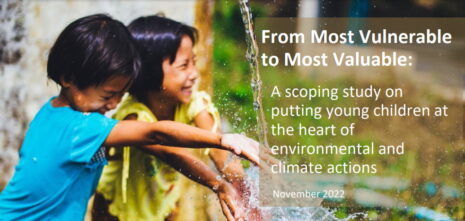
ARNEC is pleased to share the evidence from the Asia-Pacific region and the insights from experts and partners around the world exploring the deep interlinkages between climate change, environmental degradation and ECD to support the goal of enabling ECD systems and services for young children become more climate resilient, adequately funded, and their value better understood and considered by policy makers and climate scientists.Read More →